
What is happening and why?
The first World Anti-Doing Code (Code) was approved in January 2003. At that time, the World Anti-Doping Agency (WADA) committed to making sure that the Code would be a living document, which would be reviewed periodically. Since then, there have been several reviews leading to multiple revised versions of the Code.
The most recent Code review, the 2027 Code & IS Update Process, was launched in September 2023. This process was set up to allow stakeholders numerous opportunities to provide feedback on various working drafts of the Code. Following three consultation phases and extensive stakeholder feedback, the 2027 World Anti-Doping Code (2027 Code) and International Standards (Standards) were approved by WADA’s Foundation Board and Executive Committee on 5 December 2025 and will come into effect on 1 January 2027.
In the World Anti-Doping Code and International Standards Implementation Guide 2027, WADA notes the following five general themes which underline the 2027 Code amendments:
- additional focus on human rights;
- other significant changes made to address athlete interests and rights (including the expansion of the grounds to lift a mandatory Provisional Suspension, and a greater range of sanctions and more avenues for reduction);
- mitigating the potential for bias in the Doping Control Process;
- the problem of contamination; and
- increased emphasis on the responsibility of Athlete Support Personnel.
With the above themes in mind, this article provides an overview of some of the key changes in the 2027 Code.
What are the key changes?
According to WADA, the 2027 Code incorporates over 3,400 individual changes. Significant key changes include the introduction of Independent Review Experts, the reimagining of the sanctioning scheme, the expansion of reduction in sanction for early admission and acceptance, the broadening of the term “Contaminated Product” to “Contaminated Source”, and the softening of the Substantial Assistance provisions.
We now consider some of the key changes in more detail below, in the order in which they appear in the 2027 Code. Please note that this list is not exhaustive and that capitalised terms in this article have the meanings given to them in the 2027 Code, unless otherwise expressly defined.
Article 7.4 – Principles Applicable to Provisional Suspensions
Article 7.4.1 has been amended to provide that a mandatory Provisional Suspension shall be imposed when a person is first notified of the potential anti-doping rule violation (ADRV). (The 2021 World Anti-Doping Code (2021 Code) required a mandatory Provisional Suspension be imposed “promptly”, but this could often take a long time in practice, hence this amendment).
The grounds for lifting a mandatory Provisional Suspension have also been expanded to include the likelihood of a finding of no ADRV, No Fault or Negligence, or the time already served by the Athlete under the Provisional Suspension will exceed the period of Ineligibility, in addition to the likelihood that the potential ADRV is caused by a Contaminated Source.
The process for challenging the imposition of a Provisional Suspension, or failure to lift a Provisional Suspension, has also changed and the mandatory Provisional Suspension applicable to Adverse Analytical Findings for Non-Specified Substances will no longer apply to Substances of Abuse.
Article 7.8 – Cases Subject to Review by Independent Review Expert
A new Article 7.8 has been introduced as a direct consequence of the Chinese swimming matter. The 2027 Code now also includes the following defined term for an Independent Review Expert:
The role of the Independent Review Expert is to review those rare cases where … an Anti-Doping Organization has decided not to proceed with the normal Results Management process. Two individuals will be appointed to undertake the Independent Review Expert responsibilities … – a Primary Independent Review Expert and a Backup Independent Review Expert who will serve in the event the Primary Independent Review Expert is not available to promptly review a case or has a conflict of interest. The Primary and Backup Independent Review Experts shall be legal experts having extensive experience with anti-doping Results Management and with an established reputation of integrity and fairness. Stakeholders will be invited to submit, or encourage individuals to submit, Independent Review Expert applications to WADA’s Independent Nominations Committee. That Committee will nominate at least two individuals which it believes are qualified to serve as the Primary Independent Review Expert or Backup Independent Review Expert. The Primary and Backup Independent Review Experts will then be selected by the WADA Executive Committee … .
In short, under Article 7.8, in the “rare cases” where an Anti-Doping Organisation (ADO) is considering closing a case or not proceeding with normal Results Management processes after receiving an Adverse Analytical Finding (AAF) and completing the initial review required under Article 7.2, the ADO must follow the following process:
- The Athlete must be notified of the AAF and a mandatory Provisional Suspension, if applicable, must be imposed;
- The ADO must promptly submit a request for an opinion from the Independent Review Expert as to whether public policy or other compelling reasons, taking into account the rights of and impact on clean Athletes, justify the departure from the normal Results Management process for addressing AAFs, and provide a copy of the request to WADA and the other parties entitled to appeal;
- The Independent Review Expert will issue a written opinion and recommendation to the ADO, with a copy to WADA, advising whether a departure from the normal Results Management process is justified in the particular circumstances of the case;
- After receiving the Independent Review Expert’s opinion and recommendation, the ADO must issue a written decision on whether it will proceed with the normal Results Management process or dismiss the AAF; and
- The ADO must provide copies of its decision to WADA, and the decision along with the Independent Review Expert’s opinion and recommendation, must also be provided to each other party entitled to appeal the decision.
Interestingly, the Comment to Article 7.8.1.2:
- re-iterates that this process is intended to be reserved for exceptional cases, where proceeding with the normal Results Management processes would be considered an unjustified and unconscionable result by most stakeholders; and
- provides, as an example, a case where an ADO determines it is likely that AAFs for multiple Athletes resulted from a Contaminated Source and that the Athletes have a reasonable likelihood of establishing No Fault or Negligence.
Article 10.2 – Ineligibility for Presence, Use or Attempted Use, or Possession of a Prohibited Substance or Prohibited Method.
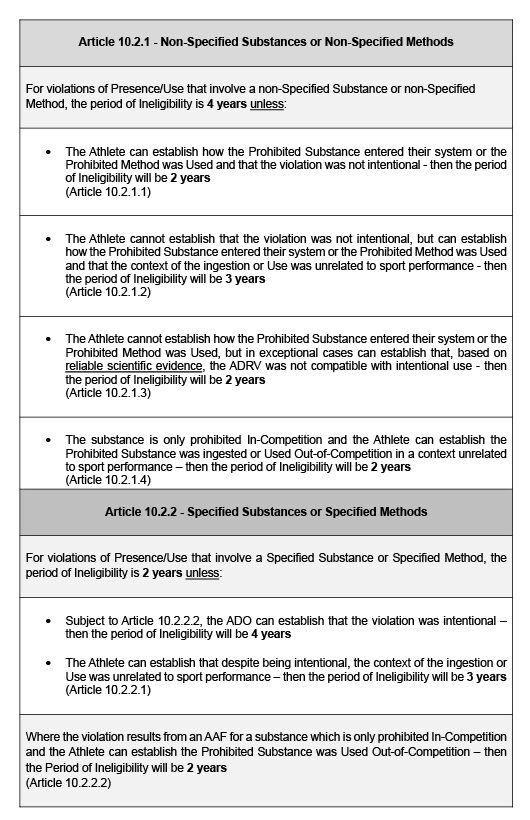
The amendments to Article 10.2 are quite extensive and complex, in an effort to make the sanctioning scheme more flexible and proportionate, by providing a framework for determining the period of Ineligibility for violations of Presence (Article 2.1), Use or Attempted Use (Article 2.2), or Possession (Article 2.6), which is based on several variables such as:
- the substance or method involved (i.e. non-Specified, Specified or Substances of Abuse);
- whether the ADRV was intentional;
- whether the context of the ingestion, Use or Possession was unrelated to sport performance; and
- whether the Athlete can establish how the Prohibited Substance entered their system.
Below are two tables which summarise the different sanctioning scenarios under Article 10.2.1 and 10.2.2 of the 2027 Code.
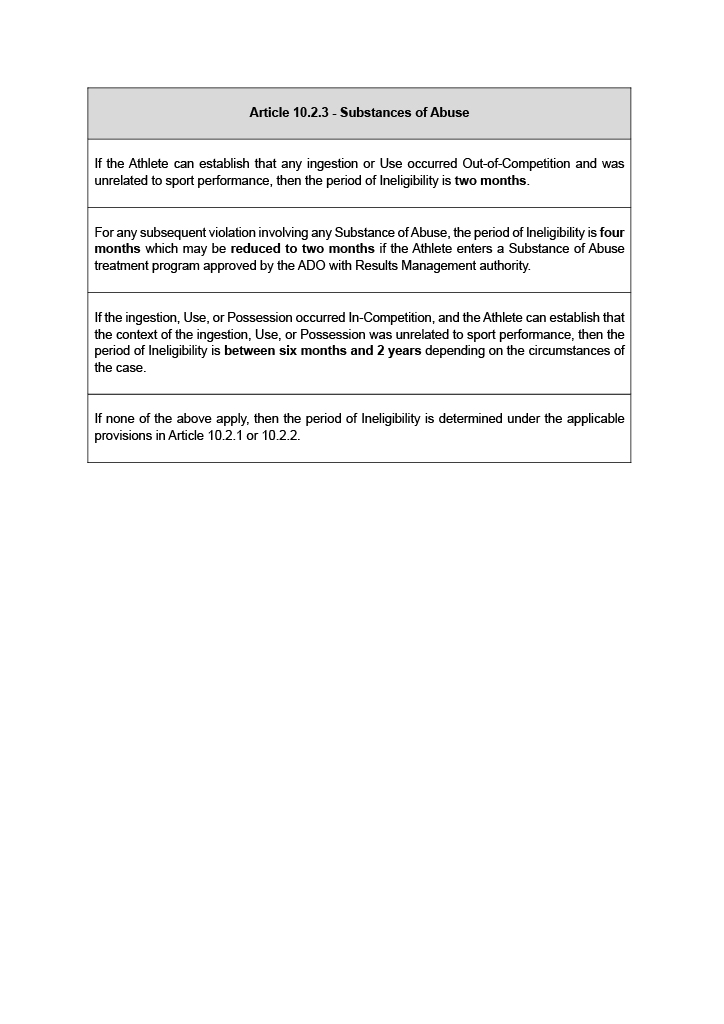
Following stakeholder feedback, the 2027 Code also contains some changes in relation to Substances of Abuse which are summarised in the table below.
A further important change has been made in relation to Therapeutic Use Exemptions, with a new Article 10.2.4 providing that where the Athlete can establish that the Presence, Use or Attempted Use or Possession met each of the criteria in Article 4.2 of the International Standard for Therapeutic Use Exemptions (except for the need to show there was no reasonable permitted Therapeutic alternative) at the time the Presence, Use or Attempted Use or Possession occurred, then the period of Ineligibility will be a flat two months. This amendment will therefore aid an Athlete who had a diagnosed medical condition at the time the Prohibited Substance was used, but did not apply for a Therapeutic Use Exemption (TUE) at the time, and is not eligible for a retroactive TUE.
The periods of Ineligibility set out in Article 10.2 can be eliminated, reduced or suspended in certain circumstances (for example, where an Athlete can establish No Significant Fault or Negligence and that the Prohibited Substance came from a Contaminated Source) and an appendix to the 2027 Code contains two helpful charts which show the application of Article 10.2 and the different factors related to sanctioning decisions and periods of Ineligibility.
Article 10.3.2 – Sanctions for Whereabouts Failures
The period of Ineligibility for a Whereabouts Failure violation is two years, subject to reduction down to a minimum of one year, if the Athlete can establish circumstances mitigating the Athlete’s degree of Fault. Article 10.3.2 now also states that Fault shall be assessed equally against all three whereabouts failures with the expectation that the Athlete should be on heightened alert after the first and second failures.
Article 10.6.1.2 – Contaminated Source
The 2027 Code contains a number of changes to address the problem of contamination theme identified by WADA. This includes replacing the term “Contaminated Product” with the broader term “Contaminated Source” in Article 10.6.1.2 (in the context of the reduction of the period of Ineligibility based on No Significant Fault or Negligence), and the addition of Article 10.2.1.3 and the reference to “reliable scientific evidence” noted above. Contaminated Source has, in turn, been defined as:
An unforeseeable source of a Prohibited Substance, such as: using or taking a medication or supplement that contains a Prohibited Substance that is not disclosed on the product label or in information accessible by a reasonable artificial intelligence or comparable search; consumption of a food or drink, such as contaminated meat or liquid, that contains a Prohibited Substance with no advance warning, disclosure or other basis to suspect that it may contain a Prohibited Substance; exposure to a Prohibited Substance through the Athlete’s direct physical contact with a third person or physical contact with objects touched or handled by the third person.
In a sign of the times, the above definition contains the first reference to AI in the Code.
Article 10.7.2 – Period of Ineligibility Reduction for ADRVs Based on Early Admission and Acceptance of Sanction
Under Article 10.7.2, if an Athlete or other Person accepts that the ADRV is established and all the asserted Consequences (including the start date of any period of Ineligibility), within 20 days of receiving the ADRV notice of charge, the period of Ineligibility will be reduced as follows:
- periods of Ineligibility of 4 years or less will be reduced by 25%;
- periods of Ineligibility of more than 4 years, but less than a lifetime, will be reduced by 1 year; and
- lifetime bans will not be reduced.
(The 2021 Code only allowed an ADRV which would result in a period of Ineligibility of four years or more to be reduced by one year. The above changes therefore expand the reduction in sanction for early admission and acceptance of sanction, thereby incentivising athletes to settle earlier and allowing the matter to be resolved without the need for a hearing).
Article 10.7.3 – Substantial Assistance in Discovering or Establishing Code Violations
The Substantial Assistance provisions have been softened with Article 10.7.3 now providing that an ADO with Results Management authority can suspend part of the Consequences imposed in an individual case where the Athlete or other Person has provided Substantial Assistance to an ADO, criminal authority, professional disciplinary body, or sport integrity authority which results in the ADO, criminal or disciplinary body, discovering facts constituting, or bringing forward a case. (The 2021 Code previously required that substantial assistance had to “result” in criminal or disciplinary action).
This Article then clarifies that the extent to which the otherwise applicable period of Ineligibility may be suspended shall be based on the value of the Substantial Assistance provided by the Athlete or other Person to the effort to eliminate doping in sport, non-compliance with the Code and/or sport integrity violations, notes that information involving the potential doping of Protected Persons and Minors shall be considered particularly valuable, and includes a Comment which provides further guidance on evaluating the value of the Substantial Assistance provided.
A new provision also allows the ADO with Results Management authority to initially suspend a smaller portion of the period of Ineligibility and later increase the amount suspended based on reconsideration of the value of the information provided.
Article 10.7.4 – Other Valuable Information and Assistance in the Effort to Eliminate Doping in Sport
This new Article gives an ADO with Results Management authority the power to suspend up to 15% of the otherwise applicable period of Ineligibility imposed in an individual case where the Athlete or other Person has provided other valuable information and assistance which does not meet all of the requirements for Substantial Assistance but is still very valuable to the effort to eliminate doping in sport (with information involving the potential doping of Protected Persons or Minors being considered particularly valuable). Once again, the extent to which the otherwise applicable period of Ineligibility may be suspended shall be based on the value of the information and assistance provided by the Athlete or other Person to the effort to eliminate doping in sport, and the ADO can initially suspend a smaller portion of the period of Ineligibility and later increase the amount suspended based on reconsideration of the value of the information provided.
What happens next?
Since the last iteration of the Code in 2021, there have been several high-profile anti-doping related matters which have clearly influenced some of the changes in the 2027 Code. Whether these changes will help prevent similar matters from arising in the future remains to be seen, but they are a positive step in the ongoing war against doping in sport.
We would recommend that all stakeholders spend time reviewing the 2027 Code and Standards now, with a view to identifying any changes that might be relevant to them and considering how best to implement these changes before 1 January 2027.
To assist with this process, WADA recently launched the 2027 Code Implementation Support Program, which contains some helpful resources on the 2027 Code and Standards, including Factsheets, Checklists and Presentations. We also understand that Sport Integrity Australia (SIA) continues to work with stakeholders alongside WADA to implement the Code changes required to be in force by 1 January 2027. Further information and updates can be found on the SIA website.
If you would like any specific advice on the 2027 Code and Standards, please contact our team of experts at SportsLawyer.
Helpful Resources
2027 World Anti-Doping Code
2027 World Anti-Doping Code and International Standards Implementation Guide 2027
WADA World Conference on Doping in Sport concludes with approval of 2027 World Anti-Doping Code and International Standards
WADA launches 2027 Code Implementation Support Program